
IP Physics Tuition @ Woodlands
Turning high-potential students into high-performance learners.
At APMC Learning Centre, our IP Physics tuition helps students build strong conceptual foundations and advanced problem-solving skills through structured training.
Many IP students grasp the ideas in class, but struggle when questions require mathematical application, deeper reasoning, or multi-concept linkage — especially in Year 3 and Year 4.
Through our APMC Focus Cycle™, every lesson follows a rhythm of guided practice, real-time correction, and repetition until mastery.
Students learn to apply principles accurately, explain reasoning clearly, and tackle non-routine IP-style questions with confidence.
Our approach supports IP Year 1–4 Physics, strengthening clarity, accuracy, and exam performance — not through more lectures, but through training.

Taught
Improvement
Subjects
Established
Why IP Physics Feels Challenging for Many Students
IP Physics goes deeper than the mainstream syllabus — requiring stronger conceptual reasoning, mathematical linking, and the ability to handle non-routine questions.
Many IP students understand the ideas (forces, motion, waves, electricity), but struggle when questions involve multi-step reasoning or concepts blended together.
IP assessments often demand clear explanations, modelling, and justification — skills that cannot be built through memorising notes alone.
Without structured practice and guidance, small gaps in logic quickly snowball into inconsistent marks.
How APMC Makes IP Physics Click
At APMC Learning Centre, we train students to think like analysts, not note-takers.
Each lesson follows the APMC Focus Cycle™ — practise, correct, reflect, master.
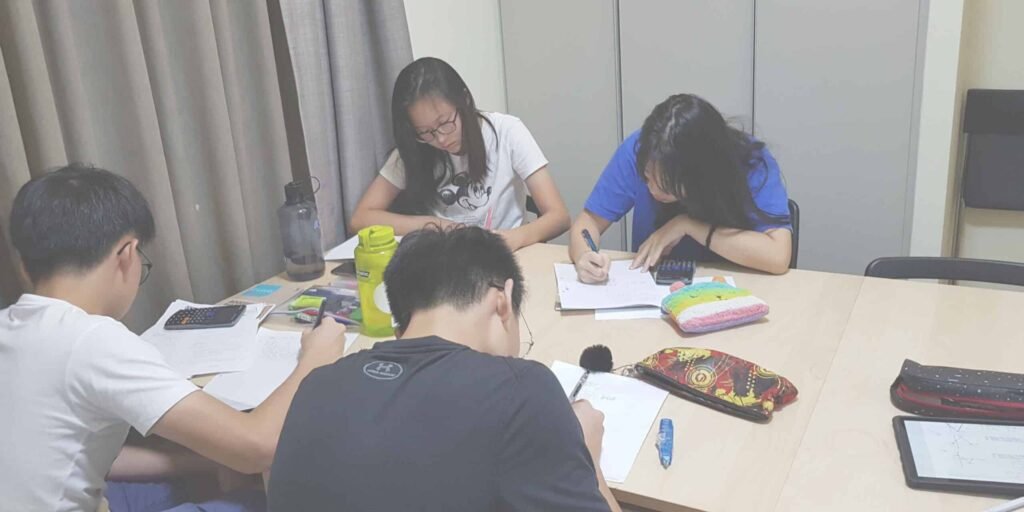
Students work on IP-style structured and application questions while tutors observe silently, stepping in only to refine logic, correct misconceptions, and sharpen method.
We focus on clarity of explanation, accuracy of reasoning, and building the habits needed for high-level analysis.
This approach strengthens conceptual understanding, exam confidence, and the disciplined problem-solving required to excel in IP Year 1–4 Physics.
Why Students Learn Better With APMC
At APMC Learning Centre, we don’t just deliver lessons. We run a proven system that trains focus, builds confidence, and gets results.

Small Group Coaching
Max 8 students, 2 tutors per session, 1-to-1 feedback during class.

Practice-Based Lessons
No lectures. Students train on real school content with guided practice.

Gamified Progress
XP points, badges, and challenges keep learning engaging and motivating.

Custom Pace Learning
Each student follows their own syllabus. Struggling learners get support, fast learners advance.

Immediate Feedback
Mistakes corrected on the spot, accelerating accuracy and exam readiness.

Smart Calendar
Semester ends in October. No wasted post-exam filler.,only lessons that matter. Optional holiday programmes available.
More Parent & Student Wins: Real Messages, Real Progress
Here’s what parents and students say after real breakthroughs. Our supportive, results-driven approach helps every child grow in confidence, performance, and motivation.

H2 Math & Physics
Hi Mr Ng, I'm Justin. I got my results back recently and managed to get an A for both physics and math. Would like to thank you for the guidance for the 2 years and affirm that your lesson style was truly effective in helping me drill on the concepts taught. Once again, really appreciate you for the effort you put in and am lucky to have joined your tuition class.
Justin
Raffles Instituition

H1 Physics
Hi Lewis!! I got my results and my promo grade for physics is a C! Thank you for helping me from U in MYE to C. Hehe.
Sharifa
Yishun Innova Junior College

IP 4 Physics
Hi Lewis, this is Edwin Goh, Elliot's father. Elliot completed his Physics paper yesterday and felt he did fine. Grades aside, I would like to thank you for guiding Elliot tje past 1.5 years. He has certainly gained tremendous confidence in Physics and even found the subject interesting! We will call upon you again if assistance is needed. Meanwhile, I wish you all the best. Cheers!
Elliot
Raffles Instituition
H2 Math & Physics
Hi Mr Ng, I'm Justin. I got my results back recently and managed to get an A for both physics and math. Would like to thank you for the guidance for the 2 years and affirm that your lesson style was truly effective in helping me drill on the concepts taught. Once again, really appreciate you for the effort you put in and am lucky to have joined your tuition class.
Justin
Raffles Instituition
H1 Physics
Hi Lewis!! I got my results and my promo grade for physics is a C! Thank you for helping me from U in MYE to C. Hehe.
Sharifa
Yishun Innova Junior College
IP 4 Physics
Hi Lewis, this is Edwin Goh, Elliot's father. Elliot completed his Physics paper yesterday and felt he did fine. Grades aside, I would like to thank you for guiding Elliot tje past 1.5 years. He has certainly gained tremendous confidence in Physics and even found the subject interesting! We will call upon you again if assistance is needed. Meanwhile, I wish you all the best. Cheers!
Elliot
Raffles Instituition
IP Physics Curriculum Focus — Built Around Your School's Papers
At APMC Learning Centre, our IP Physics tuition develops the deeper conceptual reasoning and analytical discipline required in the Integrated Programme.
IP students don’t just need to memorise principles — they must explain, justify, model, and apply concepts across unfamiliar scenarios.
That’s why every lesson centres on application-based practice, where students learn to break down complex problems and refine their reasoning.
Each session follows the APMC Focus Cycle™ — guided problem-solving, immediate correction, and repetition for long-term mastery.
We support IP Year 1–4 Physics, adjusting question difficulty, depth, and skill expectations to match the higher demands of the IP curriculum and its non-routine assessment style.
Mechanics, Taken Further
- Kinematics using vectors and motion graphs
- Dynamics and Newton’s laws applied to linked systems
- Moments, equilibrium and turning effects
- Work, energy and power used as problem-solving tools
- Momentum and collisions, where your child’s school introduces them
Year 3 and Year 4 mechanics is where most IP students first feel the jump — questions stop testing one idea at a time.
Thermal Physics and Waves
- Kinetic model of matter and thermal energy transfer
- Temperature and the thermal properties of matter
- Wave behaviour: reflection, refraction and diffraction
- Light, optics and the electromagnetic spectrum
- Sound, and superposition where the scheme extends to it
IP papers lean hard on explanation — students must justify what happens and why, not simply name the effect.
Electricity, Magnetism and Practical Work
- Static electricity, current and D.C. circuits
- Practical electricity and circuit analysis
- Magnetism, electromagnetism and induction
- Investigative practicals, data handling and lab write-ups
- Extension topics your child’s school adds beyond the mainstream scheme
Because every IP school writes its own papers, we teach from your child’s own notes, tutorials and past-year papers.
Every IP Physics session opens with timed question sets drawn from your child’s own school topics and past papers — not a generic worksheet bank.
Tutors watch the working as it happens, catch weak reasoning early, and correct it on the spot.
Over a term this builds the three things IP papers actually reward: accurate method, clear justification, and composure when a question looks unfamiliar.
What IP Physics Tuition Looks Like at Each Stage
Year 1 and Year 2 — building the habits early. IP schools move through foundational Physics faster than the mainstream track, and they bring in algebraic treatment sooner. Our IP Physics tuition at this stage is less about rescuing grades than about installing method: setting out working so a marker can follow it, handling units and significant figures without being reminded, and reading a question for what it is actually asking rather than which formula it resembles. Students who build these habits in Year 1 and Year 2 rarely need remediation later.
Year 3 — where the jump is felt. This is the year most IP students first find Physics genuinely hard. Topics stop arriving one at a time. A single question may fold together forces, energy and motion, and the marks sit with the student who can justify each step rather than recall a result. We spend Year 3 on exactly that transition: multi-concept questions worked under time, with reasoning examined as it happens and corrected before it hardens into habit.
Year 4 — consolidating before the A-Level years. By Year 4 many IP schools begin bridging toward the depth expected in Year 5 and Year 6. Questions grow more open-ended, practical work carries more weight, and the quality of a written explanation starts to separate one grade from the next. Our focus shifts to precision — complete derivations, properly justified answers, and the analytical discipline that A-Level Physics assumes a student already arrived with.
Built Around Your School, Not a National Syllabus
There is no common IP Physics syllabus. Each school writes its own scheme of work, sets its own papers, and decides its own balance between written tests, practical assessment and project work — which is why a one-size-fits-all worksheet bank does so little for an IP student. Everyone in our IP Physics classes works from their own school’s notes, tutorials and past-year papers, so the practice they put in resembles the paper they will actually sit.
It also means we track schools individually. A student from one IP programme may need heavier work on derivation and proof; another may need data analysis and experimental write-up. With a maximum of eight students and two tutors in the room, that difference is manageable — each student progresses through their own material while still getting the pace, focus and momentum that a small group creates.
Our System in Action — The APMC Focus Cycle™
Every lesson follows the APMC Focus Cycle — guided practice, tutor feedback, and gamified mastery.
Every IP Physics session begins with guided practice, not re-teaching of content already covered in school.
Students work through non-routine, higher-order questions while tutors observe their reasoning and spot misconceptions early.
When errors appear, corrections and explanations happen instantly —
before wrong ideas become habits.
Through repeated Focus Cycles, students build clarity, precision, and confidence in applying concepts to new scenarios.
By the time they sit for major assessments, they’ve trained to think like analysts — not memorisers, and definitely not guessers.
Class Details at a Glance
Lesson Duration
2-hour weekly sessions for consistent master
Small Group Focus
Maximum 8 students per class, supported by 2 tutors for personal guidance.
In-Person Learning
Held at our Woodlands centre — interactive, structured, and distraction-free.
Replacement Policy
One valid replacement per month per subject, subject to slot availability.
Students Who Take IP Physics Also Learn With Us For…
Many of our Physics students also enrol in other core subjects to strengthen analytical and problem-solving skills across the sciences and math.
Explore our related IP programmes below.

Physics

Math

Chemistry

Science
Trusted by IP Parents, Proven by IP Students
Parents choose APMC Learning Centre for IP Physics because we train reasoning, not recall.
IP papers reward students who can explain and justify their thinking — so that is exactly what our students rehearse each week, on their own school material.
Through the APMC Focus Cycle™, progress shows up in the working long before it shows up in the grade.


 Trustindex verifies that the original source of the review is Google.
 Trustindex verifies that the original source of the review is Google.
 Trustindex verifies that the original source of the review is Google.
 Trustindex verifies that the original source of the review is Google.
 Trustindex verifies that the original source of the review is Google.
 Trustindex verifies that the original source of the review is Google.
 Trustindex verifies that the original source of the review is Google.
 Trustindex verifies that the original source of the review is Google.
 Trustindex verifies that the original source of the review is Google.
 Trustindex verifies that the original source of the review is Google.
Ready to Turn IP Physics Into a Strength?
Join the IP families who found that Physics clicks once a student is trained to reason — not told to revise harder.
Let the APMC Focus Cycle™ build the precision and confidence your child’s school papers demand.
IP physics moves faster than most parents expect, and it assumes a specific list of mathematics from day one — here is what that list contains.