The short answer: PSLE Science is not a memory test, and a child who treats it as one will score well in the multiple-choice booklet and then lose the grade in the other one. Forty of the hundred marks are awarded for reasoning written down, about a situation your child has never seen before.
Most parents in this position have the same bewildered observation. Your child talks about science at home. They explain things at dinner, they are curious, they clearly know it — and the paper keeps coming back with marks that do not match the child you are looking at. That mismatch is not imagined, and in PSLE Science it has a specific cause.
What MOE actually says PSLE Science is testing
The 2023 Primary Science syllabus is unusually direct about this. Describing the Practices of Science, it states that the discipline is:
more than the acquisition of a body of knowledge (e.g., scientific facts, concepts, laws, and theories); it is also a way of thinking and doing.
The syllabus then lists what that thinking involves — posing questions and defining problems, designing investigations, analysing and interpreting data, constructing explanations, and communicating, evaluating and defending ideas with evidence.
Read that list again as a parent buying assessment books. Almost none of it is content. All of it is assessed.
Where the PSLE Science marks actually are
PSLE Science is one paper of 1 h 45 min, split into two booklets — and the split changed for the 2026 cohort:
- Up to PSLE 2025 — Booklet A was 28 multiple-choice questions for 56 marks; Booklet B carried 44 marks.
- From PSLE 2026 — Booklet A is 30 multiple-choice questions for 60 marks; Booklet B is 10 to 11 structured questions for 40 marks.
If the figures in your head are 56 and 44, they were correct until last year. Four marks have moved from the written booklet to multiple choice, and Booklet B is now described as structured questions rather than purely open-ended ones. The total and the 1 h 45 min are unchanged.
Do not read the four marks as good news. Booklet B still decides the PSLE Science grade, for the reason that follows.
Booklet A rewards recognition, and it is the half of PSLE Science most revision prepares for. A child who has revised diligently can do well here, which is exactly why the trouble stays hidden until the overall grade arrives.
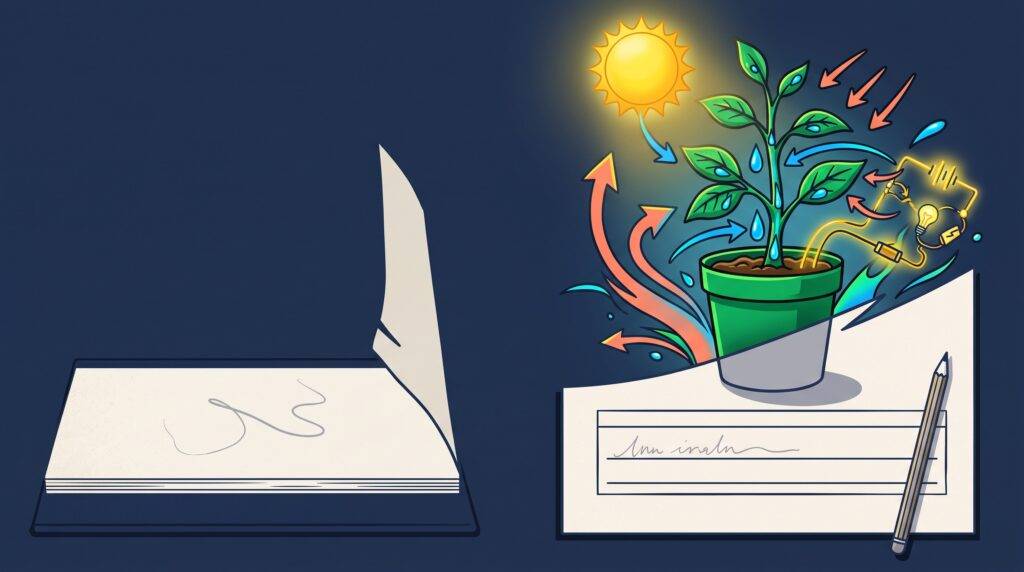
Booklet B is different in kind, not just in difficulty. It presents a scenario — an experiment, a set-up, a table of results — and asks the child to explain what is happening in that scenario, using the information given. The concept being tested is usually one they know. The task is not remembering it.
Why a child who knows the content still loses PSLE Science marks
Three failures account for most lost PSLE Science marks, and none of them are gaps in knowledge.
Answering from memory instead of from the question. The child recognises the topic, writes the textbook explanation they have learned, and never refers to the specific set-up in front of them. The science is correct. The answer does not address the question, so it does not score.
Stating the concept without applying it. “Because it is a good conductor of heat” is half an answer. The mark usually requires the concept and what follows from it in that situation. Children stop at the first half because at home, stopping there sounds right — and it does sound right, which is why parents rarely catch it.
Writing what they mean rather than what they said. A ten-year-old who understands perfectly can produce a sentence an examiner cannot award. This is a writing problem wearing a science costume, and it is very fixable — but not by revising more science.
This year’s cohort is the first under the new syllabus
Worth knowing if your child is in P5 or P6 now. The 2023 Primary Science syllabus states that implementation started with the 2023 Primary Three cohort — which reaches P6 in 2026.
So this year’s PSLE Science candidates are the first to be examined on it, exactly as they are in primary mathematics. Older practice papers remain useful, but they were written against a different document and the older mark split, and the emphasis on reasoning and investigation is stronger now than the materials in most homes reflect.
What actually helps in PSLE Science
This is narrower than it sounds and does not need more content.
Make them underline what the question gives them before answering. Most Booklet B marks are recoverable simply by forcing the answer to mention the specific scenario.
Ask “and therefore?” at home. When your child gives you half an explanation, do not correct it — ask what follows. That single question trains the second half of the answer, which is where the mark usually is.
Mark their writing, not their understanding. Read an answer as an examiner who cannot see inside their head, and who may only award what is actually on the page. It is an uncomfortable exercise and it is the most useful hour you can spend.
What we would tell you in person
If your child is interested in science, talks about it, and still brings home disappointing papers, please do not conclude they are careless. In our experience that child is almost never the problem — they understand the science and have not yet been taught how to put it on paper under time pressure, which is a different skill and one nobody has explicitly taught them.
It is also, genuinely, one of the faster things to fix at this age. Unlike a missing foundation, it does not need rebuilding — it needs showing. We wrote separately about telling the two apart before spending anything.
What you get back is worth more than the marks: a child who stops believing that being good at something and being able to show it are unrelated.
If you would like a second opinion on where your child currently stands, that is what a trial lesson is for. We will tell you straight.
APMC Learning Centre teaches primary science, primary maths and secondary science in Woodlands, in classes of no more than eight with two tutors in the room.